Tsholo "Splash" Motong:
Ya Balozi
Ya Balozi
Tsholo Motong lives in Soweto, South Africa, the only place in the world that gave us two Nobel Peace Prize winners: Nelson Mandela and Desmond Tutu.
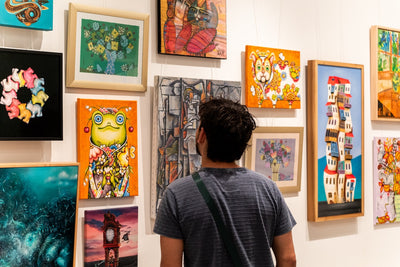
In his solo art exhibit, Motong tells us the story of the Rainbow Nation through beautifully crafted portraits of people of Soweto made with traditional South African fabric.
Table of Contents
Tsholo “Splash” Motong is a South African artist and a fashion designer.
Being born and bred in the biggest township in South Africa - Soweto, his keen inspiration has always been influenced by the vibrant & colorful lifestyle that Soweto offers.
Splash discovered his creativity and artistic potential at a young age. As a colorful artist, he relishes using bright colors (“a spice of life,” as he calls them). His main inspiration is his grandmother, hence the dominance of women in his artwork.
“She was my pillar, she raised me up from the ground up. She used to do crafts like knitting and crochet, so that’s how I started learning how to work with fabrics and colors and enjoy textures. She didn’t scold me when I told her I want to venture into this career.”
Fabric Collage
For his artwork, Splash collects fabric from different tribes and cultures in Africa. He then cuts them out in a unique mosaic fashion and glues them to canvas. Each portrait is created from hundreds of oddly shaped pieces of patterned fabric.
Whenever he uses fabrics, he ensures that they have African roots: Shweshwe from Lesotho and South Africa, Swazi from Swaziland, Kalanga from Zimbabwe, and different fabric prints from Ghana.
“I do use different fabrics from different cultures, countries and tribes to tell a single story that resonates with all the cultures.”
Soweto
Tsholo Motong lives in Soweto township, Johannesburg, South Africa. Soweto is home to more than 1.3 million black South Africans speaking Zulu, Xhosa, Sesotho, Setswana, Tshivenda, and many other local languages.
Short for South Western Townships, Soweto was created in the 1930s as temporary housing for black laborers who worked in the gold mines and other industries in the city of Johannesburg. The white-minority led government forced black people to relocate to Soweto during apartheid away from the city center.
In the 1970s, Soweto became the epicenter of the struggle against the South African white-minority apartheid. It is also the only place in the world with two Nobel Prize winners, human rights activists Nelson Mandela and Desmond Tutu.
Soweto has always influenced the country through politics, sports, music, and culture. Local scenes from Soweto inspire Tsholo's work.
Ubuntu (meaning “humanity” in Bantu) describes a set of closely related African-origin value systems that emphasize the interconnectedness of individuals. It is sometimes translated as “I am because we are” (or “I am because you are”), or “humanity towards others.”
Nelson Mandela and Desmond Tutu popularized Ubuntu to emphasize the universal bond of sharing that connects all humanity. The Ubuntu philosophy inspired Mandela and Tutu to oppose the racist South African apartheid regime and unite South Africans of all races. Tutu coined the term "Rainbow Nation" to describe the new South Africa embracing diversity and multiculturalism.
Motong creates his elaborate collages from hundreds of traditional South African fabric pieces. Like in a beautiful mosaic, he carefully constructs portraits of the people of Soweto from bright, colorful, and seemingly incompatible patterns. Yet, as if following the message of Mandela and Tutu, Motong demonstrates how different fabrics, patterns and colors can come together to create stunning identities. Each portrait has a distinctly unique personality and yet is composed of hundreds of equally unique parts.
Desmond TUTU
Desmond Tutu was born in Soweto, South Africa. He was the Archbishop of Cape Town and won Nobel Peace Prize in 1984.
“Ubuntu - the essence of being human. Ubuntu speaks particularly about the fact that you can’t exist as a human being in isolation. You can’t be human all by yourself, and when you have this quality - Ubuntu - you are known for your generosity.
We think of ourselves far too frequently as just individuals, separated from one another, whereas you are connected and what you do affects the whole world. When you do well, it spreads out; it is for the whole of humanity.”
Nelson Mandela
Nelson Mandela was born in Soweto in 1932. He won Nobel Peace Prize in 1994.
“A traveller through a country would stop at a village and he didn’t have to ask for food or for water. Once he stops, the people give him food and attend him.
In Africa there is a concept known as ubuntu - the profound sense that we are human only through the humanity of others; that if we are to accomplish anything in this world it will in equal measure be due to the work and achievement of others.”
Barack Obama
First African-American President of the United States.
Barack Obama at Mandela’s 100th birthday in Johannesburg, SA:
"Madiba teaches us that some principles really are universal. The most important one is the principle that we are bound together by a common humanity and that each individual has inherent dignity and worth.
Our differences are superficial and we should treat each other with care and respect."
Shweshwe Fabric
Tsholo "Splash" Motong extensively uses traditional African fabric in his artwork.
Shweshwe fabric is a printed, dyed cotton fabric widely used in Lesotho and South Africa. Originally dyed indigo, the fabric is now manufactured in a variety of colors with intricate geometric patterns.
Shweshwe fabric has a fascinating history. In the 17th century, the Dutch East India Company (VOC) shipped goods from East Asia to Europe through South Africa. Dutch settlers in South Africa purchased the famed naturally dyed indigo fabric made in India and Bengal.
In the 1840s, French missionaries gifted the Basotho Chief, King Moshoeshoe I indigo-printed cloth. Extremely pleased, the King endorsed the fabric, and it spread in popularity throughout the Sotho and Zulu inhabitants. The name ‘shweshwe’ derives from its royal influencer, King Moshoeshoe.
Tsholo Motong uses Shweshwe fabrics produced by the South African Da Gama Textiles founded in 1946.
Kente Fabric
In addition to Shweshwe, Tsholo "Splash" Motong uses fabric from Swaziland, Zimbabwe, Lesotho, and Ghana:
"I do use different fabrics from different cultures, countries, and tribes to tell a single story that resonates with all the cultures."
West African Kente fabric is a Ghanaian textile made of handwoven cloth, strips of silk, and cotton. Kente comes from the word kenten, which means "basket" in the Asante dialect of the Akan language, referencing its basket-like pattern.
As one of the prominent African arts and culture symbols, Kente cloth has been embraced by the broader African diaspora. Kente cloth is particularly popular in the United States among African Americans and can be found on all types of clothing, accessories, and objects.
Bògòlanfini Fabric
The bogolanfini, or mud cloths, are some of the most impressive of the African textiles. Traditionally made by the the Bamana tribe of Mali, West Africa, they were originally used for hunters' shirts and women's wraps.
The cloth is hand woven and dyed by an age old process using local flora and fermented mud.
The geometric designs that are created are often stylized forms of animals or other objects from the natural world. The zigzag motif on this cloth is known as 'the legs of a cricket'.
Tsholo Motong uses mud cloth in his several of his works.
Nkosikazi Ankara
African wax prints, Dutch wax prints or Ankara, are a type of common material for clothing in West Africa and Central Africa.
They were introduced to West and Central Africans by Dutch merchants during the 19th century, who took inspiration from native Indonesian designs.
A vibrant and colorful textile, these fabrics are typically made from 100% cotton and feature bold and intricate designs.
The term "Ankara" originates from the Hausa name for Accra, the capital of what is now Ghana. Initially used by Nigerian Hausa tradesmen, it was meant to refer to "Accra," which served as a hub for African prints in the 19th century.
Tsholo Motong uses Ankara fabrics produced by the South African Nkosikazi Fabrics SA.
Wax Prints, Vlisco
Vlisco is a high-end, expensive and fashionable Dutch Wax fabric, made in Holland. Very popular among West Africans.
Founded in Helmond, the Netherlands, in 1846, the Vlisco Group and their fabrics have grown into an essential part of African culture, receiving widespread attention from the art, design and fashion worlds.
Other similar brands include:
Tsholo Motong uses Vlisco and Hitarget fabrics in several of his works.
New Sensation
Last hour new work between time traveling of space & matter
New week new sensation of non fictional distortion
clearly crystallized cut like citrine,
loose conditions remain to reign supreme
thoughts reflected from time of space as rays glow from shine
till six turns to nine so fix the prime,
since heat turns pressure into a dime
By Splash Motong
Bombay Sunshine
New week, new work. Dark or blue blow horn like Hugh
sky hue blue as Bombay sunshine post a rainbow,
thunder drizzles across the acres,
gravitate within space of mind over matter
as the subconscious determines reality
like forces of gravity
towards speed of direction.
By Splash Motong
Tanzanite Reflections
Last hour new work between time traveling of space & matter
walala wasala wavuka way'sola,
thermal incubation dripping snow caps
deep space explorers,
ascending towards avalanche collapsing destroyers
from the apex of the Himalayas,
blizzard flakes of hydrogen gases,
fueling tanks of mountain gliding peak polars
Tanzanite reflections beaming like big time ballerz.
By Splash Motong
Ya Balozi
New week new work ascending like the morning spark
yet so far, the Venus star
torch bearer ya baLozi
the eternal flame moya we dlozi of the 7 candles & cockerels,
purity of snow as illumination cracks the limelight,
while glow sticks beam brighter than neon
By Splash Motong
Ebony Blended Ivory
Distance is time within a space of illusion or reality,
from the fragility of humanity
while hanging on loose tentacles,
with spiritualism being the apex of dimensional mentality
ebony blended ivory, like organ keys
the dark always elevates the light.
By Splash Motong
Nut-Ntu Goddess
As above so below, as within so without as the soul,
so is the ultimate universe, Thokoza makhehla 'mhlophe exiting
the phase of MA'AT to welcome
the season of NUT-NTU Goddess
of the cosmos, skies & stars beyond any galaxies,
towards the return of the Sun God from up North as aligned
with the South of the New Year during the Spring Equinox.
In honour of the harvesting from the first fruits,
towards the Reed Dance umkhosi womhlanga during
the full moon phase, mNdauwe Ase-Namaste.
By Splash Motong
London Fog
Time lapsing shifting paradigm stunting,
dlala ndukuman slender sa ma'catalog,
dripped in London Fog
DD double daks scotch never die,
Teflon non stick dry & clean like Dobbshire slacks,
lacking ants in pants turn up the single pleated,
latest ready to hang.
By Splash Motong
entrepreneurs of Joburg
Ba mkhozi ba Jozi - entrepreneurs of Joburg.
Street vendors are the backbone of our economy.
They don't wait for education, funding or fancy offices.
They just get the basics right and engage. Enterprises which uphold out families, often with babies on the back...
By Splash Motong
Auto Gymnastics
Wakker opstaan sula nge vaslap,
trap en los kwabatlela alles & tussen
stomp & vyf German Shepard from Bavaria
535 sandla semfene, drifting on quadratic double barrel
last number BBS chrome spokes of metallics
burning rubber with smoke & pipes call it auto gymnastics
By Splash Motong
Her sparkling pupil
Her sparkling pupil
is a gateway to the soul,
of her window pane,
anger & mistrust cloud the hidden pain,
relying on abusive men for financial gain
is the main aim,
she's another faceless statistic,
of brutal violence to be specific,
she's bleeding from all orifices,
her pleas are no concern to the law officers,
a victim of circumstances beyond her battle,
from craddle she was always deemed
a commodity for a few cattle
By Splash Motong
Sudden Success
Damage controller of a messy stress,
chemical imbalance under duress
mistress of sudden success aims to simply impress
faintly tainted by social conditioning
as like wolves & lambs the scales remain tipping
By Splash Motong
Amapioano, a Zulu or Xhosa word loosely translated to "the pianos", is a subgenre of house music that emerged in South Africa in the mid-2010s. It is a hybrid of deep house, jazz, and lounge music characterised by synths and wide percussive basslines.
Kofifi Jazz, Splash's favorite, is South African Jazz that was popular in Sophiatown (Kofifi), a suburb of Johannesburg. Sophiatown was a black cultural hub that was destroyed under apartheid, It produced some of South Africa's most famous writers, musicians, politicians and artists.
Explore our favorites below or here's a full playlist.