George Abramidze:
City of Love
City of Love
There's a strange attachment we develop when we visit a place. Whether through the memories we made in it or through our physical senses (smell, taste, sight, sound), we comprehend, we accept a new place in our life. It becomes a small part of our experience, and the connection to it, however thin, is with us for many years.
In September 2018, I visited the Republic of Georgia in a faraway corner of this world, sandwiched between the Black and the Caspian Sea in Eurasia. Frankly, I am not even sure if Georgia should be considered to be in Europe or in Asia because it is right on the boundary.
Georgia is one of the oldest countries in the world that adopted Christianity in the 4th century AD. It was also Georgia where in Greek Mythology, Jason and the Argonauts were looking for the Golden Fleece. It is Georgia where the rich traditions of wine-making, unique cuisine, unique script, and unique people meet modernity with one of the most unique visual arts traditions in the world.
And maybe this video can lift its veil just a tiny bit. And it was in Tbilisi where I met George Abramidze, a contemporary Georgian artist.
George Abramidze was born in 1966 in Georgia. He graduated from art school in 1983. In 1988-1991 he studied in Kharkiv State Institute of Arts in Ukraine, and in 1993 he graduated from Tbilisi State Academy of Arts. Since 1989 had participated in multiple international and group exhibitions in Georgia and abroad.
In his art, he focuses on easel painting, monumental paintings, graphic sculptures, large installations and objects.
George is a member of the Artists Union of Georgia, BBK Bundesverband Bildender Künstlerinnen und Künstler (Federal Association of Artists, Germany), and the International Federation of Artists UNESCO. His works are in public and private collections in Georgia, Azerbaijan, Armenia, Lithuania, Turkey, Russia, Slovakia, Greece, Spain, France, China, and the USA.
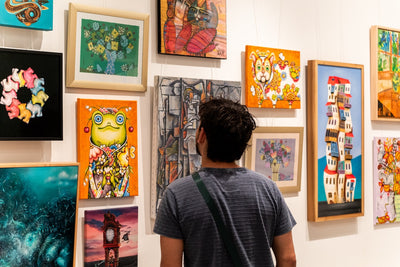
In his series of paintings, "City of Love", George attempts to recreate houses of Tbilisi, his native town. Tbilisi known for its hospitality, wine and hanging out with friends until dawn.
These houses resemble swallow nests built on the side of a cliff nested one on top of the other. These dwellings are always open to guests and visitors, they’re welcoming and alive. These houses will remind you that they’re also your houses and an ever-lasting live history is preserved in them from the ancient times until today. And that new history must be written with the same romanticism, tenderness, happiness, humor, joy and love by you.
Niko Pirosmani
Niko Pirosmani(1862–1918) was a self-taught, "primitivist" painter who is now considered the most iconic figure in Georgian art. Living a life of extreme poverty in Tbilisi, he painted for food and wine, often creating his works on black oilcloth because he couldn't afford canvas. His style is characterized by a stark, haunting simplicity and a profound sense of dignity, focusing on the everyday life of Georgian peasants, animals, and the legendary feasts of the supra.
Pirosmani’s work acts as a visual encyclopedia of late 19th-century Georgian culture, blending folk traditions with a deeply personal, almost mystical vision. His portraits, such as the famous "Actress Marguerite," and his depictions of monumental figures like the "Fisherman in a Red Shirt," possess a monumental stillness that feels both ancient and modern. Although he remained largely unrecognized during his lifetime, his "naïve" style eventually caught the attention of the Russian and European avant-garde, who saw in him a raw, uncorrupted genius.
Today, Pirosmani is a national hero in Georgia, his face appearing on the 1-laris banknote and his paintings hanging in the world’s most prestigious galleries. His tragic life—marked by isolation and a legendary, unrequited love for a French dancer—has become the stuff of national folklore. He died in obscurity in 1918, but his legacy remains the ultimate symbol of the Georgian spirit, bridging the gap between the humble reality of the street and the timeless heights of high art.
Natela Iankoshvili
Natela Iankoshvili (1918–2008) was a pioneering Georgian Neo-Expressionist who became the first woman to hold a solo exhibition at the National Gallery in Tbilisi. She is best known for her dramatic use of a pitch-black or dark green background, a signature technique that made her vibrant, jewel-toned colors appear to glow from within the canvas.
Defying the rigid requirements of Soviet Socialist Realism, Iankoshvili focused on the emotional and spiritual essence of her subjects rather than literal accuracy. Her work spanned hauntingly beautiful landscapes of the Georgian highlands and expressive portraits that captured the psychological depth of her subjects. Her travels to Cuba and Mexico in the 1960s further expanded her palette, introducing a global, modernist flair to her art.
Having no biological children, Iankoshvili famously considered her paintings to be her offspring and bequeathed over 1,000 works to the state to establish her own museum in Tbilisi. Today, she is celebrated as the spiritual heir to the legendary Niko Pirosmani and remains one of the most significant figures in 20th-century Eastern European art.
David Kakabadze
David Kakabadze was a true visionary who viewed the canvas as a space for scientific research, blending his training in physics with a deep reverence for Georgian heritage. He is most famous for his Imereti landscapes, which utilized a "bird's-eye" perspective and flattened geometric planes to map the Georgian countryside. By treating the land as a rhythmic, structured "motherland," he created a visual language that was simultaneously ancient and strikingly modern.
During his years in Paris, Kakabadze moved into the vanguard of international modernism, experimenting with "subjectless" painting and biomorphic abstraction. He pushed the boundaries of the medium by incorporating non-traditional materials like mirrors, metal, and glass into his collages to explore the concept of "internal light." His innovative work gained the attention of figures like Marcel Duchamp and was exhibited at the Brooklyn Museum alongside legends like Mondrian and Miró.
When he returned to Soviet Georgia, Kakabadze was forced to adapt to the rigid dogmas of Socialist Realism, which officially branded his avant-garde style as "formalist." He pivoted toward industrial themes and monumental stage designs, famously using his mathematical precision to create immersive theatrical environments. Even under state pressure, his art remained a subtle act of resistance, maintaining a structural complexity that defined the core of the Georgian modern movement.
Elene Akhvlediani
Elene Akhvlediani was a prominent Georgian painter and graphic artist who, along with David Kakabadze, helped define 20th-century Georgian modernism. She is most famous for her urban landscapes of Old Tbilisi, which she rendered with a poetic, "fairy-tale" quality that captured the city’s unique wooden balconies and winding streets. Her work transformed traditional architecture into vibrant, rhythmic compositions that emphasized the soul of Georgian urban life.
During the 1920s, Akhvlediani lived and studied in Paris, where she exhibited alongside legendary figures like Modigliani and Picasso. Her European period refined her use of bold color and expressive lines, blending the influence of French Impressionism with her deep-rooted Georgian sensibilities. This international exposure allowed her to bring a sophisticated, global perspective back to her homeland, influencing generations of future artists.
Upon returning to Georgia, she faced the pressures of Soviet Socialist Realism but successfully pivoted to theatrical design and book illustration to maintain her creative integrity. She designed sets for major theaters in Tbilisi and Moscow, bringing her distinctive architectural eye to the stage. Today, her house-museum in Tbilisi stands as a testament to her legacy as a guardian of Georgia’s aesthetic heritage and its historical charm.
Sno
There's this understated harmony in this painting by George. On the three color background of the black land, green nature and blue sky, there's a crooked house. Yet, the house fits perfectly into its environment, enhances and completes it. Who lived there before? Who lives there now? Who's going to live there next?
Smile of a stranger
Along with his happy houses, George is displaying his versatility with this series of abstract paintings. Abstracts don't have recognizable figures and symbols, they're completely open to viewer's interpretation. Intentionally. And every time, we ask George to explain us the meaning of this works, he politely declines :)
Georgian Wedding
Dinners in Georgia last for hours. It is a long tradition, especially when a guests visit your house. Anthony Bourdain has a great episode on it. Let's just says that even Bourdain, who tried almost every cuisine in this world, could barely get up after a real Georgia meal.
Dartlo
Yet, besides just painting Georgian houses, Abramidze's series is a great example of study in form. His two-dimensional paintings are sculptures on canvas where their form is just as important as the colors he is using. A simple geometrical rectangle changes our perception of his work through different aspect ratio, through curved lines, textures of stucco, position of windows and balconies.
Sasakhle
Notice how changes in form affect our feelings about a painting. Seemingly almost the same, yet totally different character and personality. That personality of immovable objects is what surprises us. These are not just cold and inanimate objects, but quite the opposite. There's something intriguing, dynamic and alive about them.
Fish Princess
George Abramidze also often mixes abstract and figurative styles. The line between them is always blurry. In this surrealistic work he painted a rainbow fish yet framed it with a nice abstract background and bright backlighting.
But yet, to understand George Abramidze's work, it is important to see the context, the environment where he lives and creates, his lovely Republic of Georgia.
References